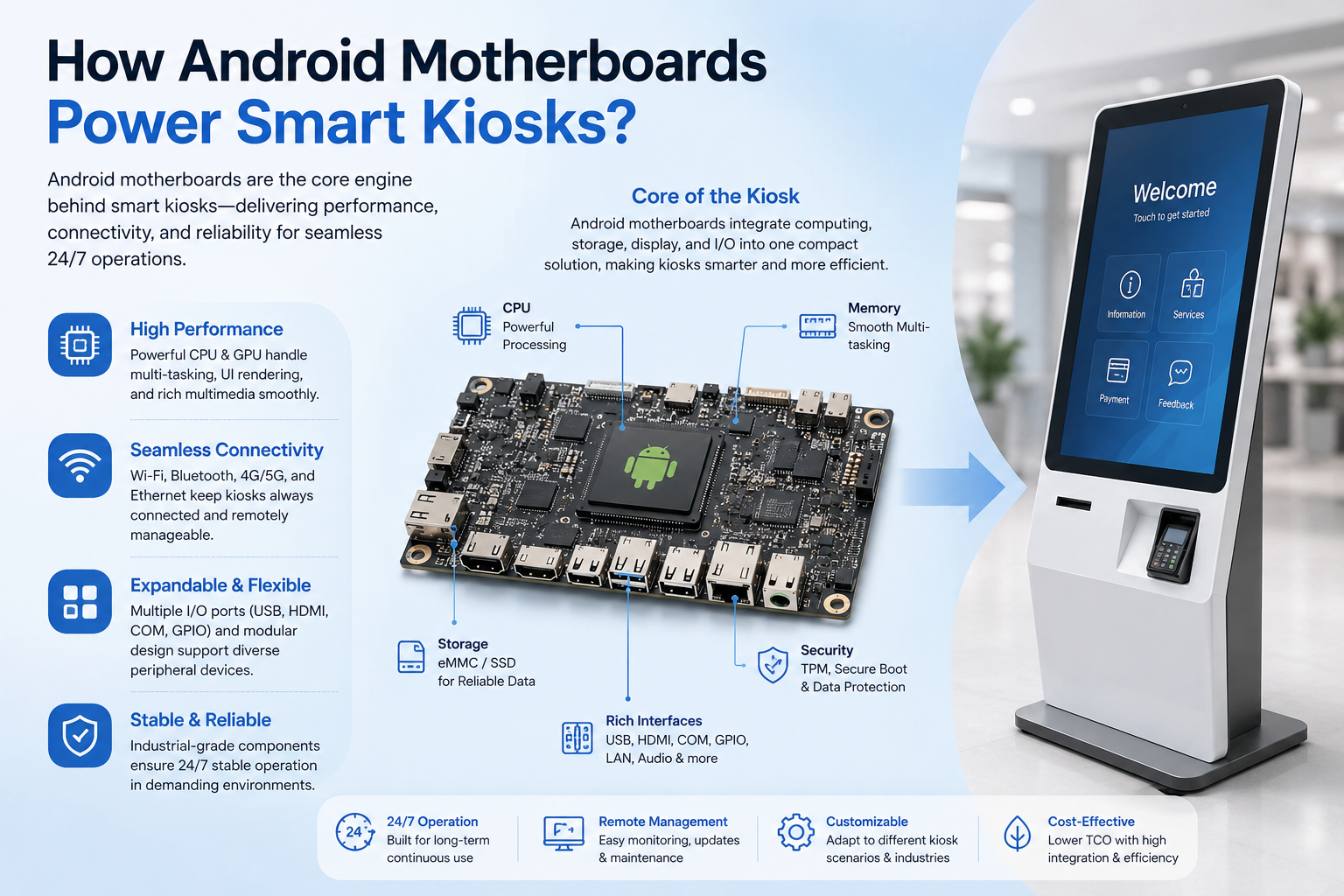
The smart display market is at an inflection point. From interactive flat-panel displays (iFPDs) and commercial signage to industrial HMIs and face recognition terminals, the hardware bar for display intelligence keeps rising. System integrators and product engineers are no longer just asking “does it drive a screen?” — they’re asking whether the platform can decode 8K content, handle real-time AI inference, maintain five-nines uptime on a factory floor, and still fit inside a thin-bezel display enclosure without active cooling. The Rockchip RK3576, as implemented on the YNH-536 smart motherboard, answers all of those questions with a platform built around practical engineering tradeoffs rather than spec-sheet theater.
This post breaks down the RK3576 architecture, explains why its key design decisions align well with smart display requirements, and details what the YNH-536 brings to the table in terms of I/O flexibility and peripheral integration.
The RK3576 Architecture: Balancing Compute, Graphics, and Power
At the heart of the YNH-536 is the Rockchip RK3576, an octa-core 64-bit SoC built around a big.LITTLE topology: four Cortex-A72 cores handling high-throughput tasks at up to 2.2 GHz, paired with four Cortex-A55 cores handling background services and efficiency-sensitive workloads. This split matters more than the headline frequency. In a display system running Android 14.0, the scheduler can park UI rendering on the A72 cluster, offload network stacks and sensor polling to the A55 cluster, and avoid spinning up all eight cores for routine operations — translating directly into lower sustained power draw and reduced thermal load.
The GPU is an ARM Mali-G52 MC3. This is not an entry-level GPU. The G52 MC3 supports OpenGL ES 3.2, Vulkan 1.1, and OpenCL 2.0, meaning it is capable of driving complex UI compositions, hardware-accelerated browser rendering, and GPU-compute workloads simultaneously. For digital signage or industrial HMI use cases that rely on smooth 60 fps UI animations layered over live video feeds, the G52 MC3 provides headroom that cheaper, single-core GPU configurations simply cannot.
The VPU (Video Processing Unit) is where the RK3576 gets genuinely impressive for its class. Hardware-accelerated decoding supports H.264, H.265, VP9, AV1, and AVS2 up to 8K @ 30 Hz. Hardware encoding supports H.264 and H.265 at up to 4K @ 60 Hz. For a smart display application, this means the SoC can accept a raw 4K camera feed, encode it locally for recording or streaming, and simultaneously decode a remote 4K stream for display — all in hardware, without burdening the CPU cluster. On competing platforms at this price tier, that combination typically requires an external video encoder chip, adding BOM cost and board area.
The NPU: On-Board AI Inference Without a Co-Processor
Integrated directly into the RK3576 is a Neural Processing Unit rated at 6 TOPS (tera-operations per second). This is a meaningful number for smart display applications. Face recognition at a check-in kiosk, object detection for retail analytics, gesture control for touchless interfaces, and license plate recognition for vehicle access control are all inference workloads that fall comfortably within the 6 TOPS envelope when using INT8-quantized models.
The alternative — offloading inference to a cloud API — introduces latency, creates a hard dependency on network availability, and accumulates per-call costs at scale. Running inference locally on the NPU eliminates all three of those liabilities. For any deployment where sub-100ms response time or offline operation is a requirement, the integrated NPU is not a luxury; it is a fundamental architectural requirement, and the RK3576 delivers it without adding a discrete AI accelerator.
Display Pipeline: Multi-Interface, Multi-Screen, 8K Output
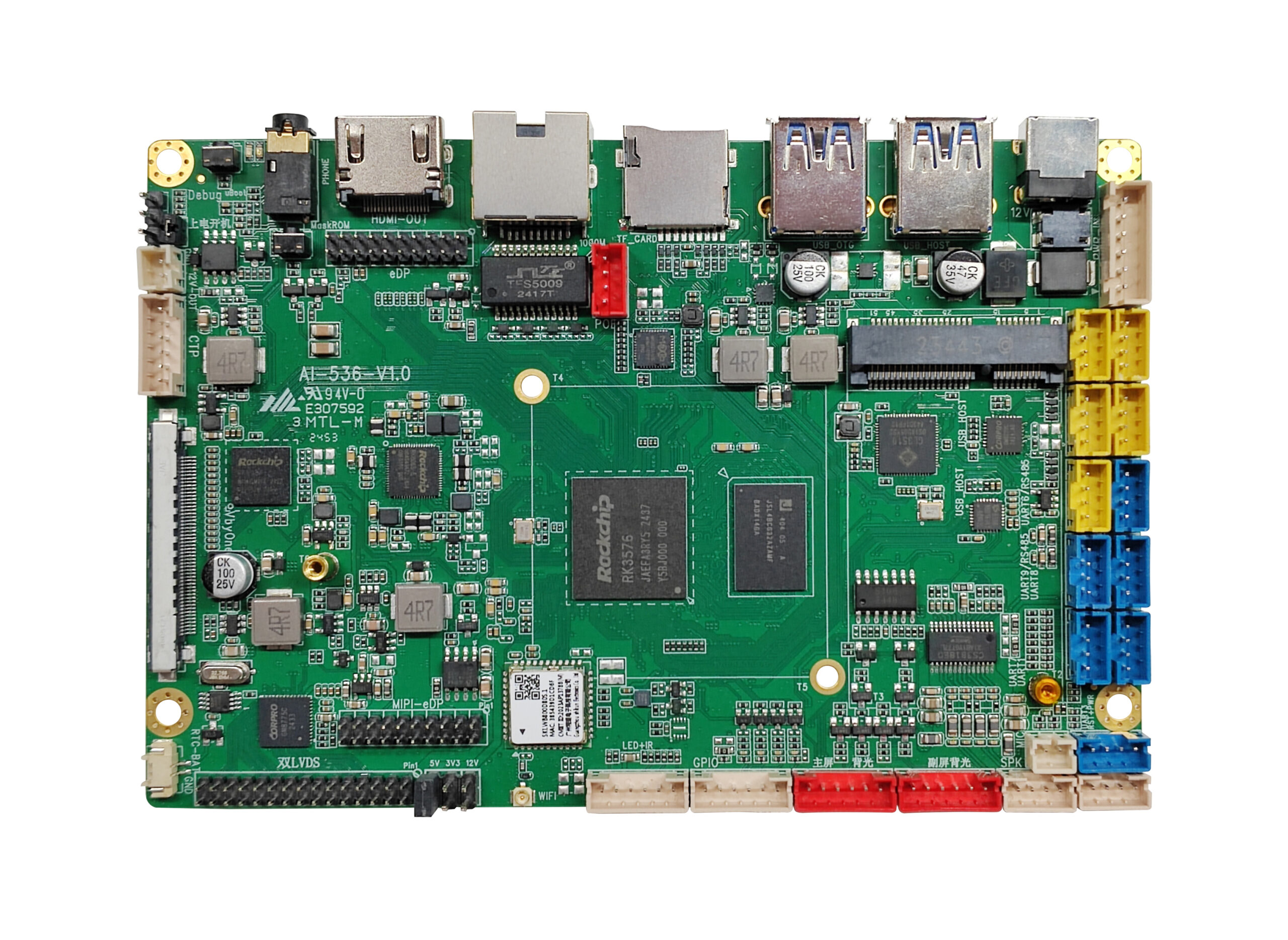
Smart display products rarely need just one display. The YNH-536 supports an extensive range of display interfaces that cover virtually every LCD panel technology in current production:
- Dual-channel LVDS — the workhorse interface for industrial and medical panels in the 7–21 inch range
- eDP — the preferred interface for high-resolution laptop-grade panels and thin-bezel commercial displays
- HDMI — standard for commercial signage monitors, projectors, and consumer-grade screens
- 2× MIPI DSI — for smaller embedded displays common in kiosks, vehicle HMIs, and portable devices
- Vbyone (optional) — the interface increasingly used by large-format 4K and 8K TV-grade panels
- MIPI IN — for camera and video source input at the display side
The ability to simultaneously drive multiple outputs enables split-zone or multi-display configurations from a single board, reducing system BOM and eliminating the need for a secondary video controller. The RK3576’s display controller supports 8K output resolution, which positions the YNH-536 for both current-generation 4K deployments and next-generation 8K signage installations without a hardware revision.
Network Connectivity: Three Independent Paths to the Network
For a smart display deployed in a commercial or industrial setting, network reliability is often more critical than raw bandwidth. The YNH-536 provides three independent connectivity options, each suited to a different use case:
1. Gigabit Ethernet with PoE The onboard 1000BASE-T Ethernet port supports Power over Ethernet (PoE), allowing the board to receive both data and power over a single CAT cable. This is significant for ceiling-mounted signage, wall-embedded kiosks, and any installation where running a separate power line is impractical. PoE also simplifies remote management: the display can be power-cycled remotely via a managed PoE switch without physical access.
2. Dual-Band Wi-Fi 6 with Bluetooth 5.4 The onboard Wi-Fi 6 (802.11ax) module supports both 2.4 GHz and 5 GHz bands simultaneously, providing OFDMA-based channel efficiency in dense RF environments — relevant in retail or event spaces where dozens of displays compete for airtime. Bluetooth 5.4 extends the peripheral ecosystem to wireless barcode scanners, BLE beacons for proximity triggering, and wireless input devices.
3. PCIe 4G LTE Module Slot For deployments outside structured cabling infrastructure — outdoor digital signage, vehicle-mounted displays, or remote industrial monitoring stations — the YNH-536 includes a PCIe slot for a 4G LTE module. Cellular connectivity serves as either a primary link or a failover channel, ensuring that a severed Ethernet cable does not take a remote display offline.
Having all three options on a single board means the network architecture decision can be deferred to deployment time rather than locked in at PCB design. A single board variant can be fielded across wired, wireless, and cellular environments.
I/O and Peripheral Interfaces: Built for Industrial Integration
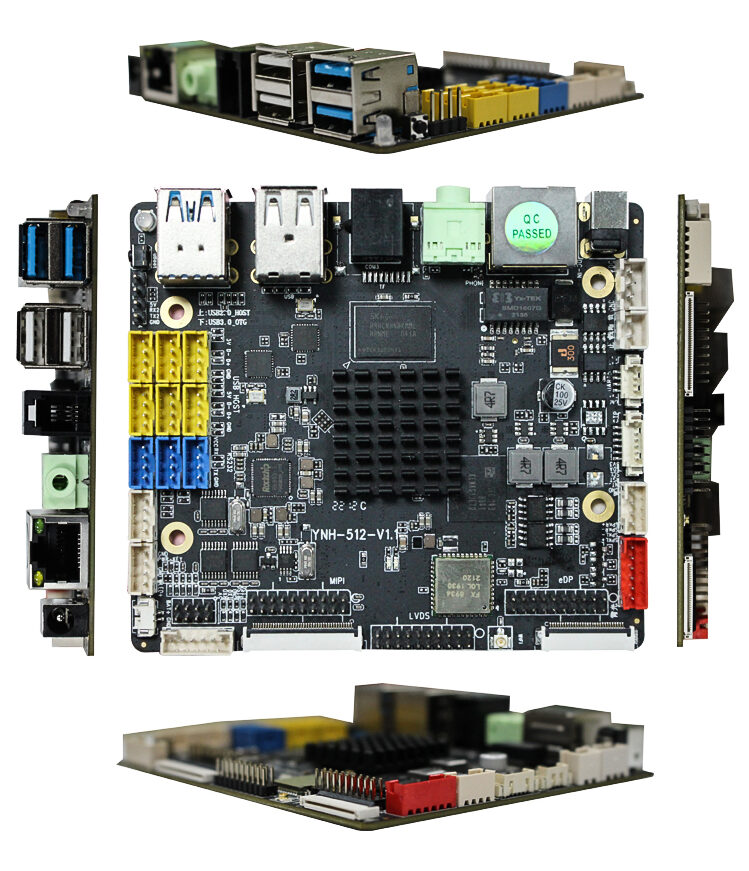
One of the most common pain points in smart display deployment is peripheral integration. The YNH-536 takes an expansive approach to I/O:
USB — 7 Ports Total
- 1× USB 3.0 OTG
- 1× USB 3.0 HOST
- 5× USB 2.0 HOST
Seven USB ports on a compact smart board is not typical. It directly addresses the real-world density of peripherals in a kiosk deployment: a card reader, a fingerprint scanner, a QR/barcode scanner, a receipt printer, a camera, a keyboard, and a USB hub can all connect simultaneously without a breakout board.
Serial Ports — 7 Total (Configurable)
- 4× RS-232 or 6× TTL (selectable, 4 I/O ports)
- 2× RS-485
- 1× Debug port
RS-232 and RS-485 remain the dominant interfaces for industrial peripherals — PLC communications, weight scales, medical instruments, industrial sensors — that have not transitioned to USB. The configurable TTL/RS-232 selection allows the same board to interface with both legacy industrial equipment and modern embedded devices without an external level-shifter. RS-485’s half-duplex multi-drop topology enables a single serial port to address up to 32 devices on a shared bus, which is critical for factory-floor and building-automation applications.
GPIO — 4 Ports Four general-purpose I/O lines are available for discrete signal control: door lock relays, light curtain triggers, alarm indicators, or hardware watchdog resets. Minimal, but present and functional.
Software Platform: Android 14.0 on Linux 5.10
The YNH-536 ships with Android 14.0 running on a Linux 5.10 LTS kernel. The choice of Android as the primary OS reflects the ecosystem reality for smart display applications: the Android developer base is large, app deployment via APK is straightforward, remote device management tools (MDM platforms, ADB-over-TCP) are mature, and the UI framework handles high-DPI, multi-touch, and hardware-accelerated compositing out of the box.
The Linux 5.10 kernel is notable for its long-term support designation. In an embedded deployment where the board may remain in service for five to seven years, LTS kernel selection matters for security patch availability and driver stability. The Rockchip BSP for the RK3576 on this kernel includes full hardware acceleration for the VPU, GPU, and NPU, so all the silicon features described above are accessible to application developers through standard Android APIs and Rockchip’s provided SDK.
Typical Applications
The combination of display flexibility, AI inference, rich I/O, and triple-path networking positions the YNH-536 across a wide deployment landscape:
- Interactive flat-panel displays (iFPDs): Driving large-format touchscreens in conference rooms, classrooms, and retail environments
- Commercial digital signage: 4K/8K content playback with scheduled content management and remote monitoring
- Face recognition terminals: Entry control, visitor management, and time-attendance systems leveraging the on-chip NPU
- Vehicle central control: In-cabin infotainment and fleet management displays with CAN-adjacent serial interfaces
- Industrial HMI and gateways: Factory visualization panels with RS-485/RS-232 connectivity to PLCs and sensors
- Cloud terminals: Thin-client displays with centralized compute and local I/O handling
Summary
The RK3576 is not trying to be a data center chip in a display enclosure. It is an SoC designed specifically for the compute, graphics, video, and inference requirements of intelligent display applications, and the YNH-536 builds a production-ready platform around it. The processor architecture avoids the common traps of this class — underpowered GPUs that bottleneck UI rendering, absent NPUs that force cloud dependency, or thin I/O that requires expensive breakout hardware in every deployment. For engineers evaluating platforms for smart display solutions, the YNH-536 represents a mature, flexible, and thoroughly specified option worth serious consideration.
FAQ
Q:1.What is the minimum order quantity (MOQ)?
A:We support PCBA sampling with a minimum order of 1 piece, as well as mass production. The MOQ can be flexibly adjusted according to the project.
Q:2.Do you support OEM/ODM manufacturing?
A:Yes, we offer PCBA manufacturing and material supply, OEM/ODM customization services, and can provide a complete one-stop solution to meet your needs.
Q:3.Can you provide a sample?
A:Sure
Q:4.How do I get a quote?
A:You can contact us via the website form, email, or WhatsApp, and we will provide a quote within 24 hours.
Q:5. How will you deliver my goods to me?
A: We ship by air and sea generally. In the mean time, we cooperate with international expresses such as DHL, UPS, FedEx, TNT to enable our customers to get their goods rapidly.