The Rockchip RK3588 isn’t just another system-on-chip. It’s an architectural inflection point — a processor that collapses the gap between embedded systems and workstation-class compute into a package small enough to fit in your palm. Featuring an octa-core CPU arrangement (four Cortex-A76 performance cores clocked at 2.4 GHz alongside four Cortex-A55 efficiency cores), a Mali-G610 MP4 GPU, and — critically — a 6 TOPS Neural Processing Unit, the RK3588 represents a category shift in what Android-based edge hardware can realistically accomplish.
The RK3588 Android development board is not merely a viable option, but a truly exceptional deployment platform for applications such as AI cameras, digital signage, edge computing, and smart self-service kiosks. Why does the RK3588 fit these specific application scenarios so perfectly? Furthermore, what are the key hardware and software synergy features that the RK3588 offers?
AI Cameras: NPU-Accelerated Vision at the Edge
Traditional IP cameras push raw video to a central server for analysis — a design philosophy that made sense when embedded processors couldn’t handle inferencing workloads. The RK3588 makes that architecture look antiquated.
The chip’s built-in 6 TOPS NPU is capable of running YOLOv5s at real-time frame rates without offloading to a GPU cluster. Pair this with the native hardware ISP (Image Signal Processor), which supports up to 32MP input and HDR processing, and you have a coherent camera SoC pipeline from sensor capture to neural inference — all on a single board.
On Android, this translates directly into deployment advantages. The RKNN Toolkit 2 provides a conversion pipeline from standard model formats (TensorFlow Lite, ONNX, Caffe) to the RK3588’s native NPU execution format. Engineers can quantize models to INT8 without meaningful accuracy degradation on standard object detection tasks, extracting near-maximum NPU throughput while keeping thermal load manageable.
Practical deployment patterns worth noting:
Multi-stream inference: The RK3588’s NPU can process up to four camera streams concurrently under moderate model complexity, making it viable for perimeter surveillance arrays running entirely on-device.
Wake-word + visual trigger pipelines: Android’s service architecture allows persistent background NPU inferencing at low power states, enabling event-driven architectures where full analysis triggers only on motion or audio cues.
Model hot-swapping: Via Android’s asset management APIs, inference models can be updated OTA without interrupting the camera service — a significant operational advantage in large-scale smart city or retail deployments.
The constraint worth engineering around: the NPU and GPU share memory bandwidth, so mixed workloads (inferencing plus HDMI-out display rendering) require careful pipeline scheduling. Binding NPU tasks to dedicated RKNN threads and isolating display rendering to the GPU’s own command queue is a well-documented approach that prevents the contention that would otherwise cap effective throughput.
Digital Signage: 8K Decode, Multi-Display, Zero Compromise
Digital signage is an application domain that looks deceptively simple until you’re responsible for a 50-screen deployment that needs to run for three years without hardware failure or thermal throttling.
The RK3588 addresses the core signage engineering constraints with hardware-native solutions. The VPU supports hardware-accelerated decode of H.265 at 8K/60fps and H.264 at 4K/60fps. This is not software decode with GPU assist — it’s dedicated silicon, which means the CPU and GPU remain available for content management logic, playlist scheduling, and remote management communication while the VPU handles the decode pipeline independently.
For multi-display configurations — still the dominant signage topology — the RK3588 exposes three independent display controllers driving combinations of HDMI 2.1, DisplayPort 1.4, and MIPI DSI simultaneously. A single board can drive a 4K primary display plus two secondary panels for interactive content zones, all without additional video expansion hardware.
Android’s MediaPlayer and ExoPlayer stacks on RK3588 leverage the VPU through hardware codec surface rendering, but the real engineering leverage comes from using Rockchip’s RKMedia SDK for low-latency playlist switching. Standard Android MediaPlayer implementations carry buffering latency that causes visible transitions between content items. RKMedia’s direct surface management reduces inter-clip latency to under 100ms — imperceptible in practice and essential for dynamic content that responds to audience analytics or external triggers.
Thermal management is the unglamorous but decisive factor in long-running signage deployments. The RK3588 in a properly ventilated enclosure with passive heat dissipation maintains stable performance at sustained VPU loads. The board-level thermal design — copper pour area, SoC placement relative to airflow — matters more than the SoC’s own TDP spec. Target a case ambient of no more than 45°C at the board surface; above this threshold, the SoC’s thermal throttling governor begins reducing clock frequencies, which creates stuttering artifacts that are immediately visible on displayed content.
Edge Computing: Heterogeneous Compute, Local Sovereignty
Edge computing is arguably the application category where the RK3588’s architecture is most precisely matched to the engineering problem. The challenge of edge deployments has always been providing enough local compute to make latency and bandwidth economics favorable versus cloud processing, while maintaining the power and form factor constraints that physical deployment locations impose.
The RK3588’s heterogeneous compute fabric — big.LITTLE CPU topology, Mali GPU, dedicated NPU, and a separate MCU for always-on low-power tasks — allows engineers to route workloads to the appropriate processing element rather than serializing everything through a general-purpose CPU.
In Android, this architecture is accessible through a layered abstraction stack:
- NNAPI routes neural network workloads to the NPU via Rockchip’s NNAPI delegate, with automatic fallback to GPU or CPU for unsupported ops.
- Vulkan Compute provides direct GPU compute access for non-visual parallel workloads — signal processing, cryptographic operations, simulation.
- JNI/NDK pathways give access to the A76 performance cores for latency-sensitive logic that benefits from high single-thread IPC.
This makes the RK3588 Android board a credible local inference server for IoT sensor arrays, a protocol bridge between industrial Modbus/CAN bus networks and cloud telemetry pipelines, or a real-time anomaly detection node in manufacturing quality control lines.
The PCIe 3.0 interface (available on several RK3588 carrier boards) opens further expansion: NVMe storage for local time-series databases, LTE/5G modems for backhaul-independent deployments, or FPGA co-processors for deterministic real-time control loops that Android’s Linux kernel scheduler cannot guarantee.
One engineering pattern worth standardizing: treat the RK3588 Android instance as a data sovereignty boundary. Sensitive inference results — facial recognition outputs, biometric data, proprietary process parameters — process and terminate locally. Only anonymized or aggregated telemetry transits to cloud infrastructure. Android’s Work Profile and per-app network policies make this boundary architecturally enforceable rather than merely aspirational.
Smart Kiosks: Integrating Touch, AI, and Connectivity
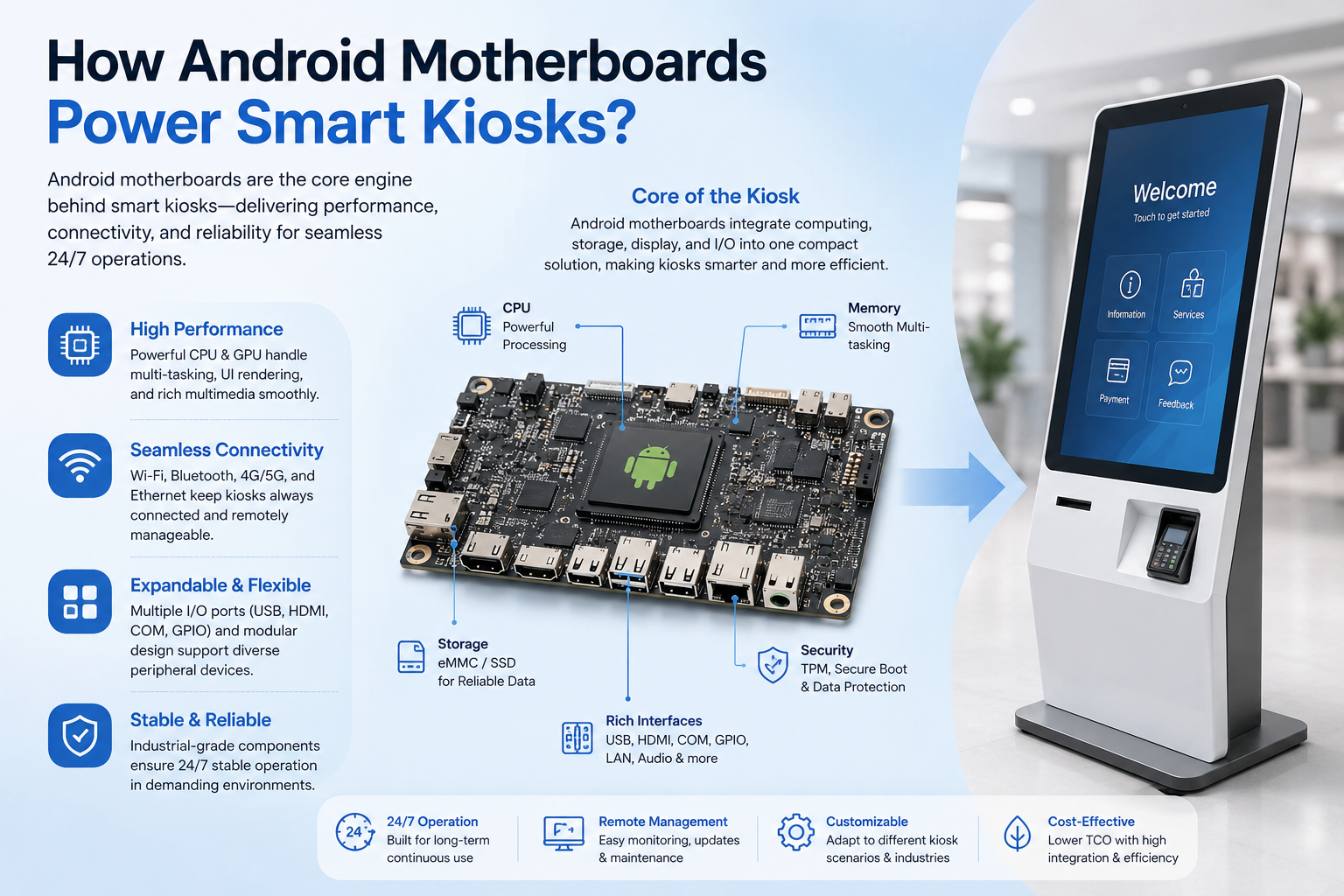
A smart kiosk is simultaneously a user interface terminal, an AI inference node, a peripheral hub, and a network endpoint. It is, in short, a stress test for whatever SoC sits at its center. The RK3588 handles this multiplexed demand profile without the component count escalation that previous-generation embedded designs required.
The touchscreen integration path on Android is mature and well-understood: MIPI DSI display output with I2C capacitive touch controller input, managed through Android’s standard InputManager and WindowManager APIs. What the RK3588 adds to this baseline is the ability to run meaningful AI workloads concurrently with full UI rendering — something that was impractical on Cortex-A53-class SoCs without visible UI frame drops.
A concrete kiosk capability matrix enabled by the RK3588:
| Capability | Implementation | RK3588 Component |
| Face verification check-in | MobileFaceNet INT8 via RKNN | NPU |
| Real-time language translation | Whisper-small ONNX | NPU + A76 cores |
| 4K promotional video loop | H.265 hardware decode | VPU |
| Capacitive touch UI | Android View framework | A55 efficiency cores |
| Receipt / label printing | USB OTG peripheral | USB 3.0 controller |
| Inventory sync | REST API over WiFi 6 | Onboard connectivity |
The engineering discipline that separates reliable kiosk deployments from problematic ones is process isolation. Android’s multi-process architecture is a structural asset here: the face verification service, the UI renderer, the video playback engine, and the peripheral communication stack should each run in separate processes with explicit memory budget constraints. A crash in the peripheral handler should not take down the AI inference service or corrupt the display pipeline.
For unattended outdoor kiosk deployments, the board’s wide operating temperature range (many RK3588 carrier boards specify -20°C to 70°C operational range) and support for eMMC 5.1 storage — more resilient to write cycle fatigue than SD card alternatives — reduce the maintenance intervention rate that makes large kiosk networks operationally expensive.
Conclusion:
The RK3588 Android board occupies a specific and defensible niche: applications that need genuine AI acceleration, high-quality media processing, and the rich peripheral ecosystem of Android, without the power draw or form factor of a GPU server. It is not a general-purpose alternative to a rack-mounted inference server for data center workloads. It is, however, precisely the right hardware for edge deployments that need to be smart, connected, maintainable, and physically compact.
The four application domains covered here share a common thread: they all benefit from moving compute closer to the data source, and the RK3588 makes that proximity economically and technically practical in ways that prior embedded SoC generations could not. For engineers evaluating platform selections in AI cameras, signage, edge computing, or kiosk deployments, the RK3588 deserves serious consideration as a primary candidate — not as a compromise, but as a purpose-fit solution.
(Note: This article was completed with the assistance of AI.)