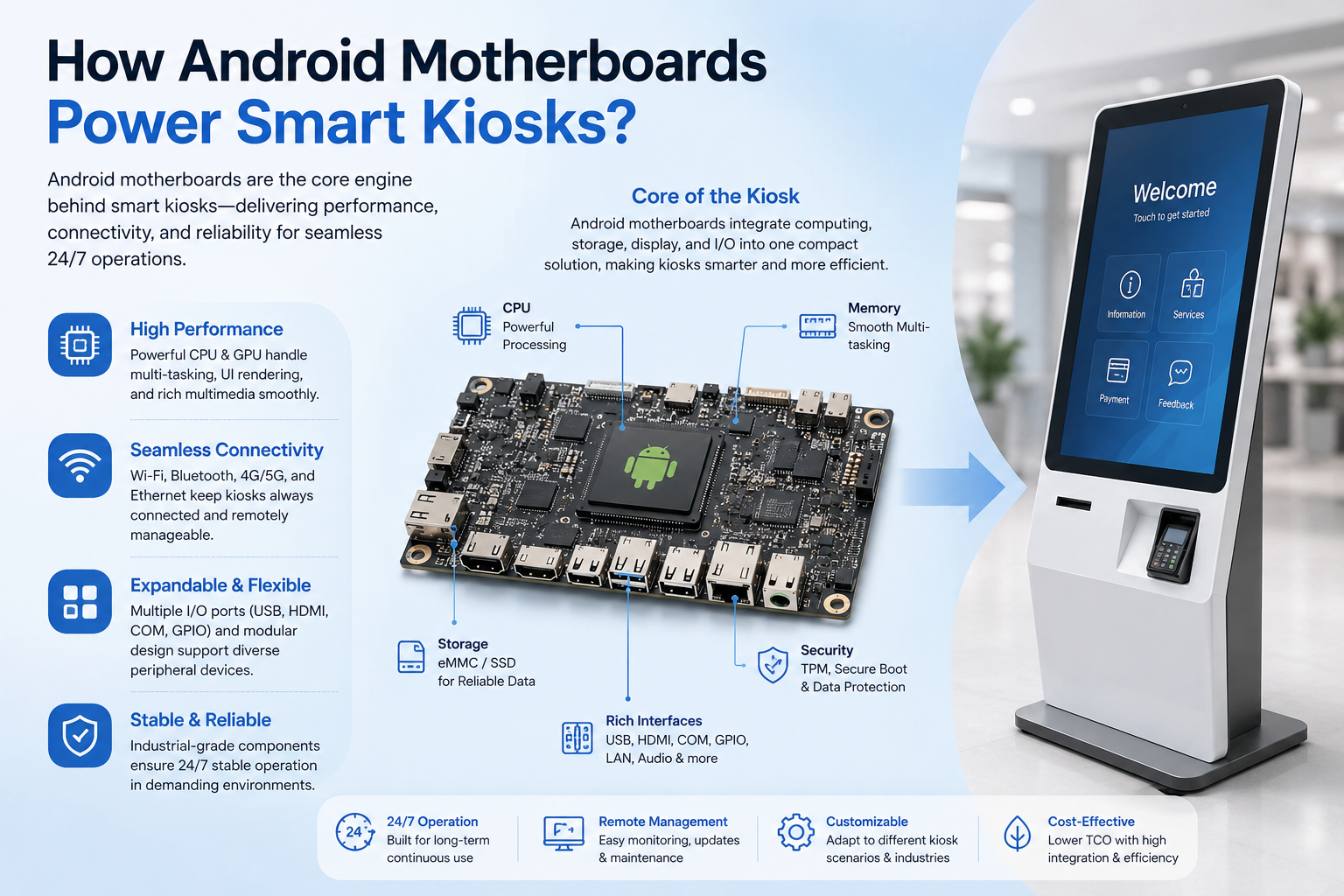
The checkout lane as we knew it is being systematically decommissioned. Across grocery chains, fast-food franchises, hotel lobbies, and transit hubs, self-service terminals (SSTs) are absorbing transaction loads that once required dedicated cashier staff. According to industry analysts, global kiosk deployments have been growing at a double-digit CAGR, and the architectural demands on the embedded hardware powering these terminals have scaled in lockstep.
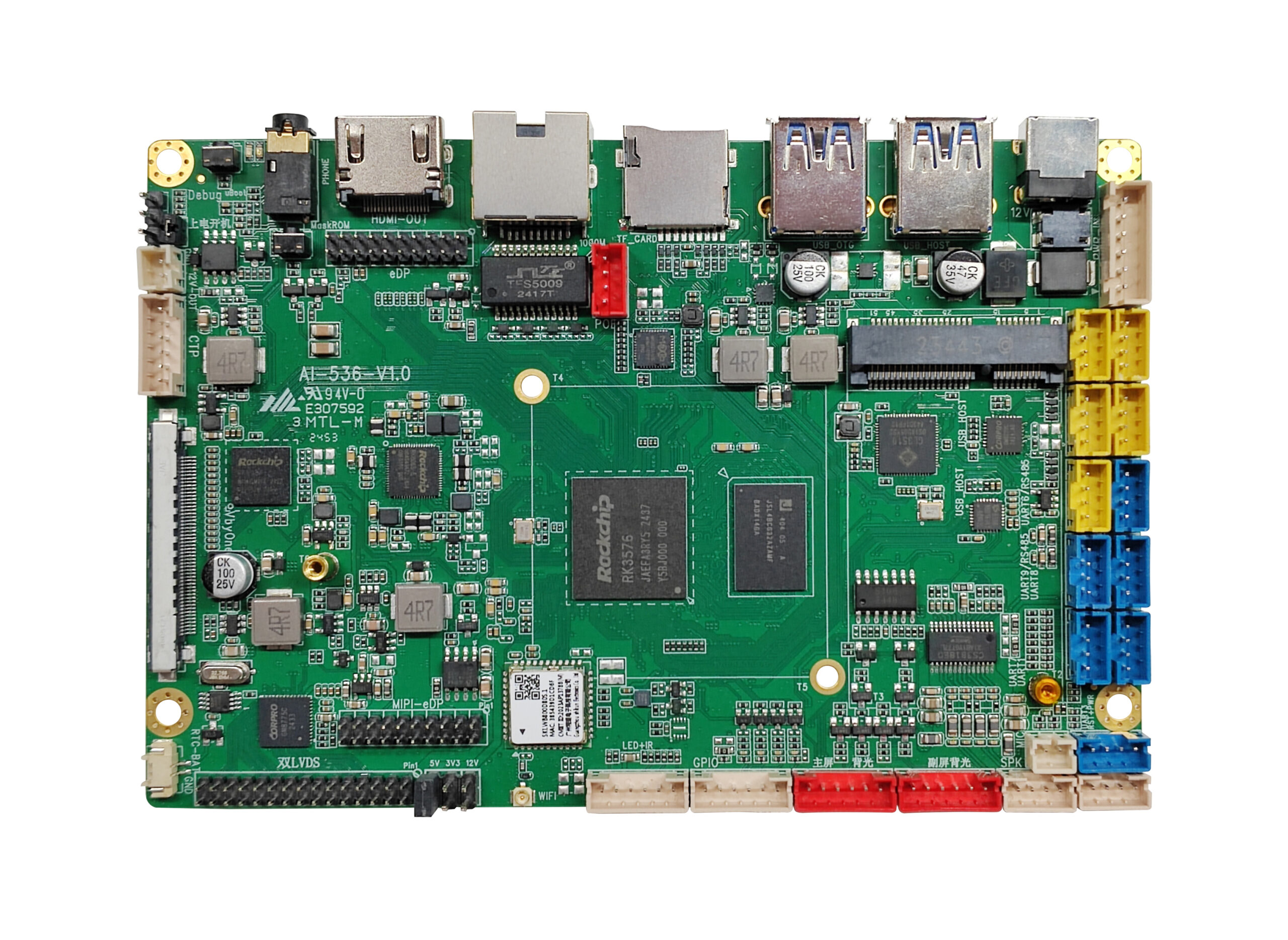
But this isn’t simply a story about replacing humans with machines. From a systems engineering standpoint, the real disruption is in what retailers now expect from their POS hardware: low idle power draw, deterministic peripheral I/O, multi-display orchestration, over-the-air update pathways, and — increasingly — local edge inference for inventory or fraud detection. The underlying silicon has to deliver on all of these simultaneously, at a cost-per-unit that makes wide deployment viable. That’s where Rockchip’s RK3566, RK3568, and RK3576 have carved out significant ground.
The Architecture Shift in Modern POS Design
Legacy POS terminals were purpose-built around x86 platforms: capable, yes, but thermally expensive, overkill for most workloads, and awkward to integrate into slim form-factor kiosk enclosures. The migration toward ARM-based SoCs was inevitable — and it arrived with a coherent value proposition: heterogeneous compute (CPU + GPU + NPU on-die), low-voltage operation, and mature Android/Linux BSP support that dramatically compresses firmware development timelines.
The POS software stack today demands more than raw CPU throughput. A modern self-checkout terminal is simultaneously running a payment UI on a primary 1080p touch display, a customer-facing receipt/ad screen, a barcode/QR decode pipeline, a thermal printer driver, a cash drawer GPIO interface, and a network stack managing both Ethernet and WiFi fallback. That’s a mix of compute-bound, I/O-bound, and display-bound workloads that need careful hardware arbitration — not brute force.
RK3566: Efficiency-First for Compact POS Nodes
The RK3566 is built around a quad-core Cortex-A55 cluster running at up to 1.8 GHz, fabricated on a 22nm process node. On paper that sounds modest. In practice, the A55’s microarchitecture is purpose-aligned with POS workloads: efficient in-order execution, shared L3 cache across cores, and predictable latency on peripheral bus transactions.
The integrated Mali-G52 GPU handles composited multi-layer UI rendering and 1080p H.264/H.265 decode without burdening the CPU cores, which stays free for application logic, driver I/O, and payment processing threads. The on-die NPU at 0.8 TOPS is enough for lightweight inference tasks — think QR code preprocessing acceleration, face detection for age verification at self-checkout liquor sales, or anomaly detection at the camera input level.
From a thermal systems perspective, the 22nm process translates to genuinely low heat generation. Passively-cooled kiosk enclosures, all-in-one panel PCs, and wall-mount terminals are practical without thermal throttling concerns — a non-trivial design constraint when the hardware is sealed inside a retail kiosk that may be bolted to a wall with no active airflow.
For single-display terminals, queue management kiosks, and ordering stations where the workload ceiling is bounded and cost efficiency is a hard requirement, the RK3566 is the rational choice.
RK3568: The Balanced Midrange Workhorse
The RK3568 steps up to a quad-core Cortex-A55 configuration with higher clock headroom and an enhanced peripheral fabric. It shares the 22nm process node but with a more capable PCIe 3.0 interface, upgraded USB 3.0 host bandwidth, and a stronger GPU allocation — making it the go-to for mid-tier self-checkout terminals that need dual-display output, faster storage I/O (NVMe over PCIe), and more headroom for simultaneous peripheral transactions.
In multi-peripheral POS environments — barcode scanner + cash drawer + receipt printer + customer display + scale integration — the RK3568’s bus architecture handles the concurrent I/O without queue stalls. Its Linux BSP support is mature, with mainline kernel patches available, which matters for operators standardizing on Debian or Ubuntu LTS builds for easier long-term maintenance and security patch management.
The RK3568 is the sensible choice for medium-complexity retail kiosks and restaurant ordering terminals where the BOM cost ceiling sits above entry-level but below the premium tier.
RK3576: High-Performance Compute for Demanding Deployments
At the top of this stack sits the RK3576, which moves to a big.LITTLE configuration with Cortex-A72 and Cortex-A53 cores, a substantially more powerful GPU, and an NPU rated for more serious inference workloads. This is the platform for self-service terminals that blur into edge compute nodes: smart retail installations with real-time computer vision, high-throughput video analytics, multi-zone digital signage coordination, or AI-assisted customer interaction.
From a developer standpoint, the RK3576’s increased memory bandwidth and PCIe 3.0 x4 capability opens up NVMe-based local storage architectures that can cache large datasets locally — useful for offline-capable POS systems that need to hold a full product catalog, pricing engine, and transaction buffer without network dependency.
For flagship self-service deployments — high-traffic transit ticketing, premium retail interactive displays, or enterprise-grade smart vending with camera-based checkout — the RK3576 delivers the compute floor necessary to run sophisticated application stacks without compromise.
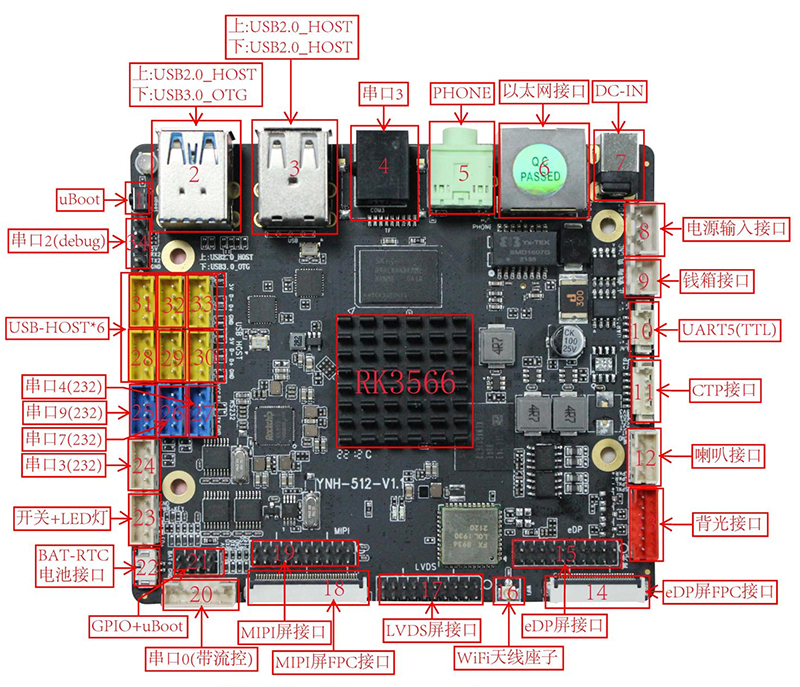
Highlights: YNH-512 — RK3566 for POS Terminal Users
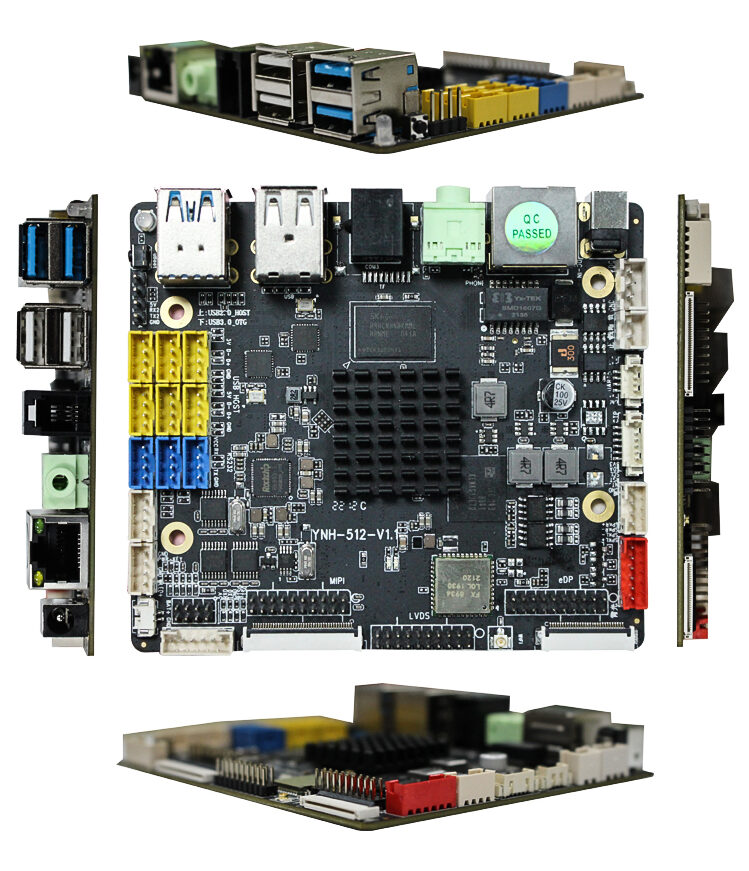
The YNH-512 is an embedded development board based on the RK3566 platform, equipped with dedicated peripheral interfaces designed for POS and self-service terminal integration.
Processor and Computing
At its core is the Rockchip RK3566 quad-core Cortex-A55 processor with a clock speed of up to 1.8 GHz, integrating a Mali-G52 GPU and a 0.8 TOPS NPU. The 22nm process node ensures the feasibility of passive cooling and enables predictable power budgets throughout the 24/7 commercial deployment cycle. Supported operating system images include Android 11.0, Linux 4.19, Debian 10, and Ubuntu 20.04, giving integrators the flexibility to choose between native Android payment applications or a complete Linux environment for custom firmware builds.
Memory configurations range from 2GB LPDDR4/4X to 8GB, and eMMC storage options range from 16GB to 64GB—more than enough to meet the needs of local product databases, receipt log archives, and OTA update staging partitions without the need for external storage.
Display Architecture
The YNH-512 supports a dual-display output configuration with multiple interface combinations:
- Dual MIPI DSI output for direct panel-to-board connections
- MIPI + LVDS or MIPI + eDP dual-screen combinations via adapter boards
- Dual-screen touch support — both displays can be touch-enabled simultaneously, which is essential for attendant-facing + customer-facing split configurations
The Mali-G52 GPU handles 1080p video decode in hardware, offloading promotional video playback or animated UI rendering entirely from the CPU cores. The optional MIPI-to-LVDS and MIPI-to-eDP adapter boards extend compatibility to legacy panel inventory, protecting existing hardware investments during platform transitions.
This is where the YNH-512’s design intent becomes explicit. The peripheral fabric is unusually rich for a board at this price tier:
- 10 USB ports: 1× USB 3.0 host + 9× USB 2.0 HOST — enough to simultaneously support a barcode scanner, customer display, receipt printer, cash drawer adapter, card reader, fingerprint module, and still have margin for expansion.
- 1× Native USB 3.0 with transfer rates up to 500 MB/s for high-speed peripheral integration or fast external storage.
- 7× Serial ports (UART) for RS-232/RS-485 devices: scales, customer displays, fiscal printers, and legacy POS peripherals that the industry has not yet deprecated.
- 3× I/O ports + GPIO/ADC for discrete signal integration — cash drawer open/close sensors, door lock controls, or hardware tamper detection inputs
This peripheral density eliminates the USB hub sprawl that plagues lower-spec boards deployed in POS contexts, reducing BOM complexity, failure points, and cable management overhead in enclosure design.
Network Subsystem
The YNH-512 covers all expected connectivity modalities:
- 10/100 adaptive Ethernet for wired backbone connectivity
- WiFi 2.4G/5G + Bluetooth 4.0 for wireless-first or hybrid deployments
- PCIe-based 3G/4G module interface — the board exposes a PCIe slot for mainstream 4G LTE modules, enabling cellular-primary or cellular-failover configurations without an external USB modem dongle
The cellular pathway is particularly relevant for temporary retail installations, pop-up kiosks, or outdoor-deployed terminals where pulling wired Ethernet is impractical.
Conclusion: SoC Selection Is a Systems Decision
The RK3566, RK3568, and RK3576 each occupy a distinct position in the embedded POS design space, and selecting among them is properly a systems engineering decision — balancing workload characterization, thermal constraints, display requirements, peripheral density, and lifecycle cost.
For integrators targeting compact, power-efficient single or dual-display POS terminals, the RK3566 platform — as implemented in boards like the YNH-512 — delivers the I/O density, display flexibility, and OS ecosystem support to build production-grade retail hardware without the overhead of a more powerful (and more expensive) SoC. The peripheral richness of the YNH-512 in particular — 10 USB ports, 7 serial ports, dual-screen touch, and 4G LTE expansion — maps directly to the functional requirements of modern self-service terminals.
The retail floor is being rebuilt on embedded ARM silicon. The engineering question is no longer whether to adopt it, but which platform aligns with your deployment’s performance envelope and integration constraints.